Welcome to CLPHA's Press Room
CLPHA experts welcome interview requests from print, radio, television, and online reporters and are happy to provide their insights on issues of public housing and related legislation and policy.
For media inquiries, please contact:
David Greer
Director of Communications
(202) 550-1381 or [email protected].
*Please let us know if you are working on deadline.
To view all of CLPHA's press releases, click here.
To view all of CLPHA's press statements, click here.
You can subscribe here to our biweekly newsletter, events invite list, and topic specific newsletters. You can also follow us on Twitter at @CLPHA. Or, send us an email with your interests and we would be happy to add you to our press lists.
Thanks again for your interest in CLPHA!
December 22, 2020
About the Council of Large Public Housing Authorities
The Council of Large Public Housing Authorities is a national non-profit organization that works to preserve and improve public and affordable housing through advocacy, research, policy analysis and public education. CLPHA’s 70 members represent virtually every major metropolitan area in the country. Together they manage 40 percent of the nation’s public housing program; administer more than a quarter of the Housing Choice Voucher program; and operate a wide array of other housing programs. Learn more at clpha.org and on Twitter @CLPHA .
About CLPHA’s Housing Is Initiative
The Housing Is Initiative, led by the Council of Large Public Housing Authorities, helps build a future where sectors work together to improve life outcomes. Housing stability is a critical first step to improve life outcomes for low-income children, families, and seniors; CLPHA’s Housing Is Initiative is based on the premise that sectors can better meet needs when they work together. Housing Is establishes, broadens, and deepens efforts to align affordable housing, education, and health systems to produce positive, long-term results. Learn more at housingis.org and on Twitter @housing_is.
|
(202) 550-1381
For Immediate Release
December 10, 2020 |
|
|
(Washington, D.C.) December 10, 2020 – The Council of Large Public Housing Authorities (CLPHA) is proud to support the nomination of Congresswoman Marcia Fudge (D-Ohio) to be the 17th Secretary of the Housing and Urban Development Department. CLPHA Executive Director Sunia Zaterman released the following statement:
"Congresswoman Fudge is a longtime champion of affordable housing, urban revitalization, and infrastructure investment. She has demonstrated her leadership as a mayor, as a Member of Congress, and as the head of the Congressional Black Caucus. She understands that racial and economic inequities are deeply rooted, particularly in our housing systems, and that working across sectors is imperative. Her many years of work on economic justice issues such as food insecurity and education access can bring much-needed leadership to aligning systems and services to better meet the needs of low-income Americans. We look forward to working with Congresswoman Fudge in her role as HUD Secretary to address the growing need for COVID emergency rental assistance and safe, affordable housing."
About the Council of Large Public Housing Authorities |
About the Council of Large Public Housing Authorities
The Council of Large Public Housing Authorities is a national non-profit organization that works to preserve and improve public and affordable housing through advocacy, research, policy analysis and public education. CLPHA’s 70 members represent virtually every major metropolitan area in the country. Together they manage 40 percent of the nation’s public housing program; administer more than a quarter of the Housing Choice Voucher program; and operate a wide array of other housing programs. Learn more at clpha.org and on Twitter @CLPHA and follow @housing_is for news on CLPHA’s work to better intersect the housing field and other areas of critical importance such as health and education.
From the Alaska Housing Finance Corporation's website:
In Alaska the term “rural” isn't just a label, it's a lifestyle that shapes our communities and experiences in ways those from outside the state may not fully appreciate. More than 80% of our communities have fewer than 1,000 residents. More than half our land mass, which is twice the size of Texas, is only accessible by plane or boat and some villages require riding a four-wheeler or snow machine after the boat or plane lands. These communities still need access to housing but many lack the capacity to take advantage of existing housing programs and are unable to expand their inventory because there are no specialized systems or workforce locally accessible even when funding is available.
Statewide Concern
In early 2023, Alaska Housing Finance Corporation surveyed state agencies to gather data and pinpoint specific communities struggling to recruit and retain workers due to housing shortages. A common thread was soon identified:
-
Due to a lack of housing, many positions essential to the community’s economic vitality are unfilled.
- Airport crews, public safety officers, healthcare workers, maintenance staff, judges and other critical professionals are struggling to find housing of any type, and sometimes end up sleeping on floors.
- Demand for housing is so extreme, properties are purchased sight-unseen before they even go on the market.
This data became the springboard for the Last Frontier Housing Initiative that connects AHFC staff, systems and infrastructure with rural community partners to help build housing.
Collaborative Solutions
A combination of federal and state funds allowed AHFC to embark on a once-in-a-generation opportunity to incentivize local governments in Western and Southeast Alaska with incentives for new housing construction.
To jumpstart housing builds, AHFC offered to be a design-build partner with local governments in five of the most remote communities in the United States – Ketchikan and Sitka, on islands in Southeast, and Bethel, Nome and Kotzebue that are off the road system in Western Alaska.
The proposal was direct. Administered through a grant process, AHFC would award roughly $24 million in construction funding on a government-to-government basis with a simple proposition:
- The construction funding is yours if you choose to accept it;
- Where overlapping jurisdictions exist, i.e., borough/city/tribe, the community decides who leads;
- A minimum number of units will be built: some for state workers, others meeting federal affordable definitions;
- What is built, where and how is entirely a community call so long as minimum construction outcomes are met;
- Community partners must match AHFCs funding by at least 15% in cash, land, in-kind, etc.;
- AHFC staff will be available to help grant recipients navigate the programs, visit the communities and support their efforts by reviewing draft requests for proposals, helping with admin, grant tracking, etc. – anything required from start to finish.
Community Support
The response was nearly immediate with communities bringing their own innovative ideas to the table. With basic guidelines under the proposition leading the way, support provided by AHFC was tailored to meet individual community needs. Beyond funding, AHFC’s support fell within one of two broad categories.
1. Outreach
-
AHFC staff went on-site to all five communities to meet with local elected leaders, tribal partners and community stakeholders for explanation and dialogue on the Last Frontier Housing Initiative.
2. Support
-
AHFC provided support for all partners during the procurement phase.
- AHFC staff and technology supplemented the local partners' operations in several communities.
- AHFC provided programmatic guidance and on-site training to partners who were new to the program resources, setting them up for long-term success once the properties converted to the operations phase.
By May 2024, AHFC had visited all five communities and started signing funding agreements – with construction starting soon after.
“Consistent with AHFC’s past practices, we listened, we followed through, and we worked with our partners to build housing they were unable to build on their own." - Bryan Butcher, CEO/Executive Director, AHFC
Real Results
The Last Frontier Housing Initiative moved fast, exceeded unit expectations, came in under budget, and the first units are online.
-
New units built (63) exceeded baseline expectations by 45%;
- $9.8 million in match funding beat projections by 173%;
- $584,000 costs per door were below models by 8%.
Due to the success of the Last Frontier Housing Initiative, in 2024, the Alaska Legislature created a new $4 million program with intent for AHFC to expand its housing partnerships with four statewide agency landholders to catalyze new housing developments, and it renewed the Last Frontier Housing Initiative. Both were supported by Governor Dunleavy.
“Structuring the Last Frontier Housing Initiative as a government-to-government partnership allowed AHFC to build and execute housing plans with our community partners rather than for them," said Butcher. "This buy-in and partnership enabled each of the five communities to leverage their respective strengths with AHFC’s resources to drive housing solutions most appropriate for their needs.”
Creating Opportunities
The success of the Last Frontier Housing Initiative is due in large part to AHFC’s diligent monitoring of allowable uses of restricted dollars, thought leadership and ingenuity, leveraging congressionally appropriated ERA-2 but expiring housing assistance with more flexible state resources. This diligence and creativity led to new resources allocated to continue work that is making a meaningful difference in housing construction statewide. The Phase I efforts including the original five communities paved the way for $22 million in additional resources to be deployed to seven new communities in Phase II of the Last Frontier Housing Initiative.
In September 2025, AHFC expanded the effort further, closing a deal with the University of Alaska to purchase land and property across the state for the purpose of future housing development.
“Our partnerships weren’t simply staff and funding driven. We engaged with communities and stakeholders individually to maximize outcomes, which included strategic work to build awareness, generate excitement and build accountability,” said Butcher.
From the Tacoma Housing Authority's press release:
The Tacoma Housing Authority (THA) has secured new funding to rehabilitate over 300 of its existing affordable housing units. 316 households representing over 1,000 residents of northwest Salishan and Hillside Terrace 2300 will see their units updated over a two-year period. This $150 million effort will bring much needed upgrades and renovations to these decades-old properties.
Resyndication is a feature of the Internal Revenue Service (IRS) Low-Income Housing Tax Credit (LIHTC) program in which affordable housing providers seek to secure a new allocation of tax credits for the purpose of preservation, rehabilitation, and/or sustainable development. This critical tool ensures that THA has financial backing to update and renovate hundreds of units and improve the quality of life for tenants at THA family properties. This program was recently expanded by Congress and championed by Senator Maria Cantwell.
The rehabilitation project is expected to span two years, with improvements designed to enhance comfort, safety, and sustainability for families. THA is taking a strategic, staggered approach in which households will be temporarily moved to different units in their community while their home undergoes construction. The scope of work includes:
• New roofs, windows, and heat pumps
• Upgraded appliances, flooring, cabinets, and countertops
• Interior and exterior painting
• Modernized plumbing and electrical fixtures
• Comprehensive site improvements
“Salishan and Hillside Terrace are family properties at their core,” said Director of Asset Management and Real Estate Development Ken Short. “This resyndication is more than a construction project—it’s an investment in children, parents, and neighbors who deserve high-quality, safe, and sustainable housing.”
55% of households whose homes will be rehabilitated include children, and 73% are extremely low-income, earning less than 30% of Area Median Income (AMI). The average annual income of these households is $28,918.
The resyndication is backed by over $150 million in funding from multiple sources, including a $10 million award from the Washington State Department of Commerce, dedicated to energy efficiency upgrades including new windows and heat pumps with air conditioning. Citi Bank is serving as the lender for this effort, underscoring the strong financial partnerships that make this ambitious rehabilitation possible.
THA has engaged LMC as the general contractor, who will partner with local development group 1DROP to facilitate outreach and opportunities for local, community-minded small businesses to work on the project.
From the Housing Authority of the City of Los Angeles' newsletter:
Two new Panda Cares Centers of Hope are opening doors to education and opportunity for youth across HACLA communities. We celebrated the openings with ribbon cuttings at Pueblo del Sol and William Mead Homes, highlighting a major investment in youth empowerment. At Pueblo del Sol, Panda Cares and Panda Associates partnered with the Variety Boys & Girls Club to establish a new Center of Hope, creating a dedicated learning space that supports academic success, skill-building, and college and career readiness.
At William Mead, we welcomed the transformation of the community center into a Panda Cares Center of Hope through its long-standing partnership with the Boys & Girls Club of West San Gabriel Valley & Eastside. Since 2018, this collaboration has provided residents at William Mead, Ramona Gardens, and Estrada Courts with educational support, leadership development, recreational programming, and digital literacy skills.

From the Fairfax County Redevelopment and Housing Authority's press release:
Wesley Housing, The Lamb Center, Fairfax County Redevelopment and Housing Authority (FCRHA), Fairfax County, and City of Fairfax officials, and other development project partners gathered on November 3rd to break ground on Beacon Landing in Fairfax, VA. The innovative rental apartment community will provide 54 new Permanent Supportive Housing (PSH) units with wraparound supportive services to people experiencing or at-risk of chronic homelessness.
Beacon Landing is the result of a thoughtful partnership between Wesley Housing and The Lamb Center, leveraging both organizations’ complementary missions, expertise, and long histories of community service to deliver Northern Virginia’s largest permanent supportive housing community. Located in the northeast portion of Fairfax City, on the same street as The Lamb Center’s existing daytime drop-in shelter for people experiencing homelessness, the community will replace the former Hy-Way Motel site (9640 Fairfax Blvd, Fairfax, VA), which was demolished in 2024.
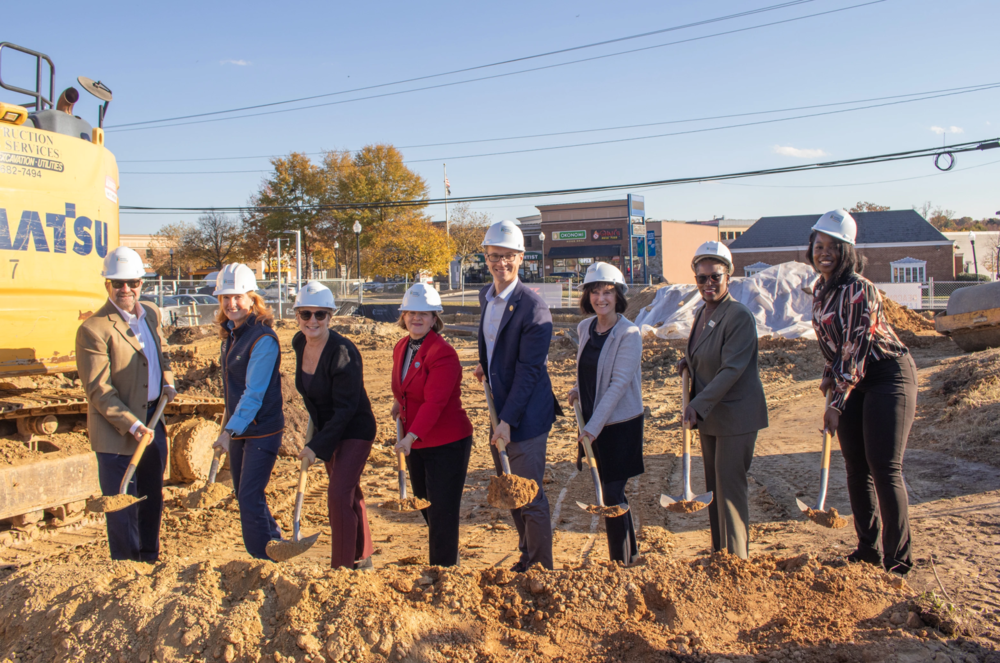
Once complete, Beacon Landing will offer primarily studio-style apartments tailored for single individuals with very low incomes. The Fairfax County Redevelopment and Housing Authority (FCRHA) awarded 48 project-based vouchers for the development. The community will feature 42 studio, 10 one-bedroom, and 2 two-bedroom apartments. The building is designed as 100% universal design and nine units will meet Uniform Federal Accessibility Standards (UFAS) and American National Standards Institute (ANSI) Type A requirements to address resident accessibility needs. The new apartment building will feature an innovative, trauma-informed, energy-efficient design and will meet National Green Building Standards (NGBS) and Zero Energy Ready Home (ZERH) requirements.
Once complete, Beacon Landing will offer primarily studio-style apartments tailored for single individuals with very low incomes. The Fairfax County Redevelopment and Housing Authority (FCRHA) awarded 48 project-based vouchers for the development. The community will feature 42 studio, 10 one-bedroom, and 2 two-bedroom apartments. The building is designed as 100% universal design and nine units will meet Uniform Federal Accessibility Standards (UFAS) and American National Standards Institute (ANSI) Type A requirements to address resident accessibility needs. The new apartment building will feature an innovative, trauma-informed, energy-efficient design and will meet National Green Building Standards (NGBS) and Zero Energy Ready Home (ZERH) requirements.
“This is not just a building; it’s a bold response to a growing need,” said Wesley Housing President and CEO Kamilah McAfee. “Beacon Landing shows what’s possible when communities like Fairfax County and City of Fairfax come together cross-jurisdictionally to invest substantial resources in housing solutions that are compassionate, coordinated, and lasting.”
The five-story, mixed-use development will include structured parking, a community space, an outdoor terrace, and office space on the ground floor, enabling an expansion of The Lamb Center’s job readiness programs to help individuals find and sustain employment. Residents will also benefit from case management and wrap-around services to support their health, stability, and independence, ranging from income and benefit navigation to life skills training and mental health support.
“Nine years ago, grounded in faith, The Lamb Center asked a simple question: ‘What is the greatest unmet need of our homeless neighbors?’ That question brought us to this moment. Beacon Landing shows what’s possible when boundaries fade and communities unite around a shared conviction — that housing is not a privilege, but a fundamental human right,” said The Lamb Center Executive Director Tara Ruszkowski.
“At the FCRHA, we are committed to removing barriers and creating access for everyone in their quest to find opportunities. Beacon Landing does just that, by providing people experiencing homelessness with homes and supportive services to help them thrive,” said Lenore Stanton, Chair, FCRHA.
From the Los Angeles Sentinel:
In honor of Veterans Day, Mayor Karen Bass welcomed servicemembers from across Los Angeles to Getty House for a luncheon recognizing their service and celebrating the early success of her “House Our Vets” initiative, a program launched in January to end Veteran homelessness in the city. The event brought together Veterans who recently secured permanent housing, property owners contributing units to the effort, and civic leaders partnering with the city to accelerate placements.
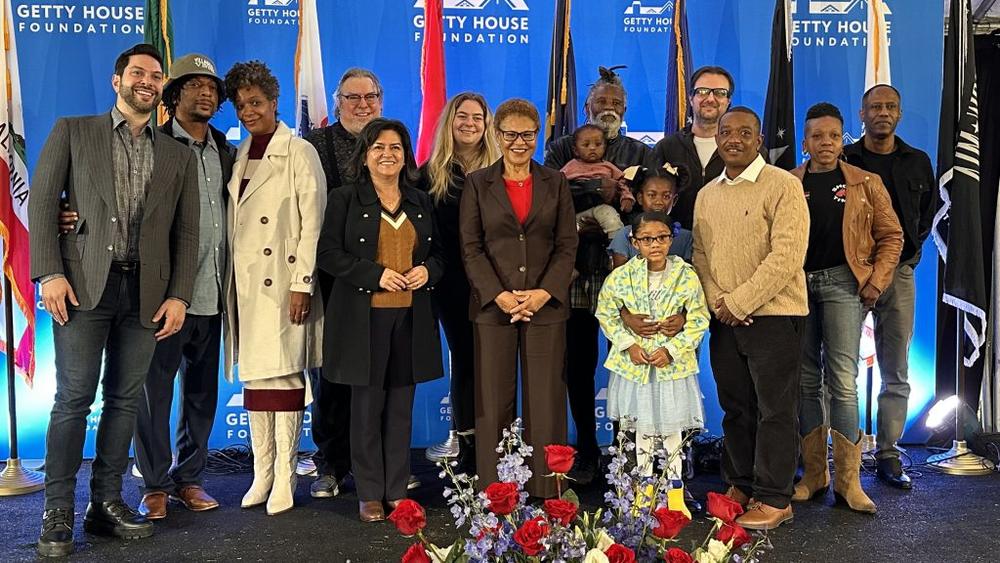
Since the program’s launch, the Housing Authority of the City of Los Angeles (HACLA) reports that nearly 400 Veterans have been housed through the HUD-VASH program, with a retention rate of 99 percent. The progress reflects major policy changes Mayor Bass championed in Washington, D.C. last year, where she led a delegation of more than 50 bipartisan mayors in pushing for the removal of federal barriers preventing Veterans from receiving both disability benefits and housing vouchers simultaneously.
“For years, federal policies forced Veterans to choose between healthcare and housing,” Bass said, addressing the crowd gathered inside the Getty House courtyard.
“No one who served our country should ever have had to make that choice. When I learned these policies left thousands of vouchers unused, I knew we had to act.”
The mayor reflected on her experience chairing the U.S. Conference of Mayors Ad Hoc Committee on Homelessness, where her advocacy helped secure HUD waivers and regulatory changes that now allow Veterans to retain their earned benefits while accessing permanent housing assistance.
Read the Loa Angeles Sentinel's article "Mayor Bass Celebrates Veterans, Highlights Progress Toward Ending Veteran Homelessness."