Welcome to CLPHA's Press Room
CLPHA experts welcome interview requests from print, radio, television, and online reporters and are happy to provide their insights on issues of public housing and related legislation and policy.
For media inquiries, please contact:
David Greer
Director of Communications
(202) 550-1381 or [email protected].
*Please let us know if you are working on deadline.
To view all of CLPHA's press releases, click here.
To view all of CLPHA's press statements, click here.
You can subscribe here to our biweekly newsletter, events invite list, and topic specific newsletters. You can also follow us on Twitter at @CLPHA. Or, send us an email with your interests and we would be happy to add you to our press lists.
Thanks again for your interest in CLPHA!
|
(202) 550-1381
For Immediate Release
February 27, 2021 |
|
|
(Washington, D.C.) February 27, 2021 – Sunia Zaterman, executive director of the Council of Large Public Housing Authorities, released the following statement upon tonight’s passage of the American Rescue Plan Act in the U.S. House of Representatives:
“The Council of Large Public Housing Authorities applauds the House of Representatives' bipartisan passage of the American Rescue Plan Act, which includes $35 billion in emergency rental and utility assistance and a significant extension of the eviction moratorium.
“This legislation is critical to address the rental crisis facing the nation. The situation has only grown worse since the Biden Administration announced the American Rescue Plan in mid-January. Renters have continued to accrue past-due rent at an alarmingly high rate. While the eviction moratorium has provided important protections for renters financially impacted by the pandemic, the moratorium has meant that millions of renters have accumulated significant arrears. Economists estimate that unpaid rent at the end of January 2021 totals $52 billion, which amounts to $5,600 for the average renter. With the March 31 moratorium on evictions rapidly approaching, additional rent assistance is urgently needed to help renters stay in their homes by addressing back rent. The Senate must act swiftly to provide emergency rental assistance and prevent a wave of evictions that will tragically disrupt the lives of millions of Americans.”
|
||
|
|
||
|
|
||
|
About the Council of Large Public Housing Authorities
About CLPHA’s Housing Is Initiative |
||
|
(202) 550-1381
For Immediate Release
January 28, 2021 |
|
|
(Washington, D.C.) January 28, 2021 – Sunia Zaterman, executive director of the Council of Large Public Housing Authorities, released the following statement upon the conclusion of the U.S. Senate Committee on Banking, Housing & Urban Affairs’ nomination hearing for The Honorable Marcia L. Fudge, of Ohio, to be Secretary of the U.S. Department of Housing and Urban Development: “The Council of Large Public Housing Authorities applauds HUD Secretary-designate Marcia Fudge’s forceful call for expanding emergency rental assistance at her Senate nomination hearing today for individuals who are facing housing instability due to lost income or are experiencing unemployment because of COVID-19, many of whom are people of color. She understands that the $25 billion allocated to emergency rental assistance in the most recent stimulus was not enough and only a down payment.
“Right now, in back rent alone, 10 million low-income renters have accrued an average of $5,600 in rental arrears, which totals $56.3 billion. The current stimulus package will help approximately 3.5 million renters pay back rent by February. The remaining 7 million renters who are unable to pay back rent will face eviction, compounding the strain on our nation’s economy and compromising our nation’s moral responsibility to address racial inequities among our most vulnerable individuals.
CLPHA calls for Congress to immediately pass President Biden’s American Rescue Plan which contains $50 billion in emergency rental assistance, and for the Senate to swiftly confirm Secretary-designate Fudge so that she can begin her imperative work.”
About the Council of Large Public Housing Authorities
About CLPHA’s Housing Is Initiative |
January 6, 2021
(Washington, D.C.) January 6, 2021 – Sunia Zaterman, executive director of the Council of Large Public Housing Authorities, released the following statement on the results of yesterday’s special election in Georgia:
“CLPHA congratulates Raphael Warnock on his historic victory and Jon Ossoff’s election to the United States Senate, thus securing a Democratic Senate majority. The incoming Biden-Harris administration and HUD Secretary-designate Marcia Fudge now have expanded, once-in-a-generation opportunities to improve the lives of low-income Americans who have been especially harmed by the COVID-19 pandemic.
The first course of action is for Congress to pass a new stimulus relief bill with $50 billion in emergency rental assistance that addresses housing insecurity and homelessness. These historic wins also provide momentum to permanently expand the Housing Choice Voucher program and recapitalize the public housing portfolio, both of which are concrete steps to eradicating poverty and dismantling systemic racism. CLPHA looks forward to working with the Biden-Harris administration and the 117th Congress to make these legislative goals happen.”
About the Council of Large Public Housing Authorities
The Council of Large Public Housing Authorities is a national non-profit organization that works to preserve and improve public and affordable housing through advocacy, research, policy analysis and public education. CLPHA’s 70 members represent virtually every major metropolitan area in the country. Together they manage 40 percent of the nation’s public housing program; administer more than a quarter of the Housing Choice Voucher program; and operate a wide array of other housing programs. Learn more at clpha.org and on Twitter @CLPHA .
About CLPHA’s Housing Is Initiative
The Housing Is Initiative, led by the Council of Large Public Housing Authorities, helps build a future where sectors work together to improve life outcomes. Housing stability is a critical first step to improve life outcomes for low-income children, families, and seniors; CLPHA’s Housing Is Initiative is based on the premise that sectors can better meet needs when they work together. Housing Is establishes, broadens, and deepens efforts to align affordable housing, education, and health systems to produce positive, long-term results. Learn more at housingis.org and on Twitter @housing_is.
The Housing Opportunities Commission of Montgomery County and partners cut the ribbon on The Lindley, a 200-unit high-rise in Chevy Chase, MD. The opening of The Lindley constitutes a net increase of 22 units of affordable housing in the neighborhood. You can watch a time-lapse video of The Lindley’s construction here.
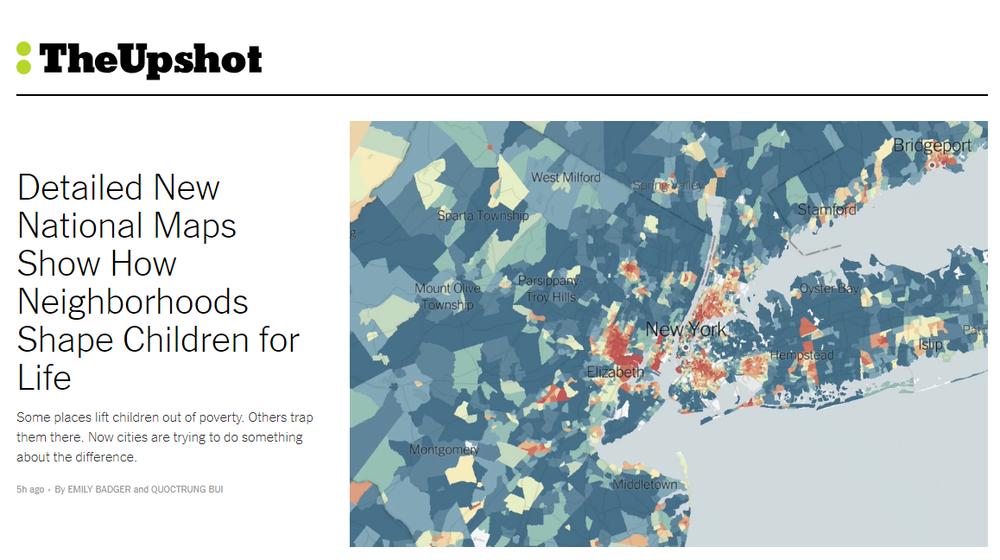
The long-awaited Opportunity Atlas, published today by the Census Bureau in collaboration with researchers at Harvard and Brown, got top billing on today’s homepage of the New York Times’ data-driven digital property The Upshot. “Detailed New National Maps Show How Neighborhoods Shape Children for Life,” includes the new interactive mapping tool, some of the project’s main findings, and examples of the mobility work that public housing authorities are currently doing, and plan to do, with the data. In addition to quoting Raj Chetty, one of the project’s researchers, authors Emily Badger and Quoctrung Bui feature quotes and examples from CLPHA members Greg Russ, Executive Director of the Minneapolis Public Housing Authority, Andrew Lofton, Executive Director of the Seattle Housing Authority and Andria Lazaga also of SHA who each discussed how PHAs are using the data as part of their Creating Moves to Opportunity (CMTO) work.
Additional news coverage of the Opportunity Atlas includes an NPR segment during today’s Morning Edition broadcast that features interviews with Chetty and local officials in Charlotte, NC, who intend to use the data to shape future policy decisions.
Read the article and use the interactive maps on the NYT website and listen to the Morning Edition story on NPR’s site.
On August 9, HUD sent the 2017 Worst Case Housing Needs Report to Congress, providing national data and analysis of critical problems facing low-income renting families throughout the nation. The report, which is HUD's 16th in a longstanding series, chronicles an increase in severe housing problems, with the number of households considered to have worst case housing needs jumping from 7.72 million in 2013 to 8.3 million in 2015. HUD also reports that, since 2007, the U.S. has seen a 41 percent increase in severe housing problems, and a 66 percent increase since 2001. The Worst Case Housing Needs Report defines households with worst case needs as very low-income renters who do not receive government housing assistance and who paid more than one-half of their income for rent, lived in severely inadequate conditions, or both.
Using data from the 2015 American Housing Survey, HUD found that the economic benefits of an improving national economy are not reaching the lowest-income renter households and that overall severe housing problems are on the rise. The report acknowledges a large shift from homeownership to renting as playing a major role in the increase of worst case housing needs, noting that, "modest gains in household incomes were met with rising rents, shrinking the supply of affordable rental housing stock in an increasingly competitive market."
You can view the 2017 Worst Case Housing Needs Report by clicking here.
On August 1, the Senate Finance Committee held a hearing, “America’s Affordable Housing Crisis: Challenges and Solutions.” The hearing focused primarily on the challenge of increasing the supply of affordable housing and strategies to address the significant housing cost burdens faced by many Americans. Senator Hatch opened the hearing, stating that the affordable housing crisis, “is a problem that should be ready for a bipartisan solution.” To view our write-up of the hearing, click here.
To help tackle the affordable housing issues discussed in the hearing, Senators Orrin G. Hatch (R-UT) and Maria Cantwell (D-WA) have introduced legislation, S. 548, the Affordable Housing Credit Improvement Act. The bill would increase Low-Income Housing Tax Credit (LIHTC) credit authority by 50 percent, as well as enact roughly two dozen changes to strengthen the program by streamlining program rules, improving flexibility, and enabling the program to serve a wider array of local needs.
During the hearing, Committee Members expressed their support for the Cantwell-Hatch bill and there was broad bipartisan consensus that the LIHTC program is a vital tool for increasing the production of affordable housing and providing low-income households, safe, quality, affordable homes. However, there were also concerns raised regarding oversight and compliance of the program. Daniel Garcia-Diaz, director of financial markets and community investment at the U.S. Government Accountability Office (GAO), presented testimony that IRS oversight of LIHTC is minimal and that there are no robust controls in place to ensure reasonableness of costs or compliance with program requirements. According to Mr. Garcia-Diaz, the GAO recommends that HUD, as an agency with a housing mission, play a greater role in the oversight of the program.
In our Statement for the Record, CLPHA applauded the leadership the Senate Finance Committee has shown in support of LIHTC to date and encouraged the Committee to support S. 548. The bill is especially beneficial to the public housing program, which has experienced decades of underfunding and federal disinvestment. We noted that LIHTC has proven to be an extremely important preservation tool for public housing, and PHAs have a long history of leveraging private equity through LIHTCs to fill the funding gap created by decreased federal appropriations. Without the LIHTC program, preservation of their public housing stock would not be possible.
CLPHA also acknowledged that competition for more valuable 9% LIHTCs is fierce in many states and that there have been concerns within the affordable housing community about increased demand from the public housing portfolio. Increasing the allocation authority by 50 percent would support the preservation and construction of up to 400,000 additional affordable apartments over a ten-year period, including the renovation of vital public housing units that are currently at-risk. Additionally, the legislation allows for an increased basis boost for projects serving extremely low-income households. This would be particularly beneficial to housing authorities, as 75 percent of public housing residents are extremely-low income.
CLPHA has been strongly supportive of the legislation. In addition to the Statement of Record above, CLPHA has also engaged in this work as a member of the A.C.T.I.O.N. Campaign Steering Committee (A Call to Invest in Our Neighborhoods). The A.C.T.I.O.N. Campaign has taken a lead role in promoting the expansion of LIHTC, including support of S.548. Last month the Campaign submitted a letter to Senator Hatch in response to his request for comments on tax reform, urging Congress to expand and strengthen the housing credit. Along with other Steering Committee members, CLPHA endorsed and signed the letter.
As Congress takes on tax reform in the upcoming months, we will continue to support this important legislation that would provide needed resources to public housing. CLPHA members should support the Affordable Housing Credit Improvement Act by contacting their senators during recess to urge them to support the bill.
Two-Generation Economic Act reflects the cross-sector collaboration that CLPHA’s Housing IsInitiative promotes.
Senators Susan Collins (R-ME) and Martin Heinrich (D-NM) recently reintroduced bipartisan legislation in the Senate, calling for the development of support programs that improve family economic security by breaking the cycle of multigenerational poverty through a comprehensive strategy that addresses the needs of parents and children. The Two-Generation Economic Act of 2017, or S. 435, seeks to align and link existing service systems and funding streams that currently support parents and children separately. Heinrich and Collins believe that aligning the support systems to help parents and children together will increase the whole family’s chances for success in life. The bill also establishes the Interagency Council on Multigenerational Poverty to provide guidance on two-generation programs; establish a system of coordination among agencies and organizations; identify best practices; and identify gaps, research needs, and program deficiencies.
The Two-Generation Economic Act of 2017 is a significant step in the fight against poverty. It would be the first piece of legislation to incorporate a two-generation approach aimed at increasing economic security, educational success, social capital, and health and well-being for parents and children together. In seeking to better align service systems and funding streams, the bill would give states, local governments, and tribes more flexibility to develop programs that meet their specific needs. The approach outlined in S. 435 would greatly improve the effectiveness of service delivery, and it highlights the same principles and goals around which CLPHA’s Housing Is initiative was founded, to better intersect housing and other sectors in order to improve life outcomes. CLPHA has long promoted two-generation initiatives as a best practice and has been a leader in fostering partnerships to encourage innovative solutions to address generational poverty.
The Interagency Council on Multigenerational Poverty will create a national focus on multigenerational poverty by facilitating coordinated efforts across multiple agencies and departments. This interagency collaboration will align and link fragmented systems and funding streams, resulting in holistic approaches that simultaneously address the needs of children and their parents or guardians.
A collaboration that has been in the works for several years, the Two-Generation Economic Empowerment Act includes a balance of input and interests from local service providers, families, administrators, and other stakeholders. Heinrich and Collins hope that this innovative approach will help collectively ensure that people will have an opportunity to use already existing federal resources or attract private investment to implement the two-generation approach in their community, regardless of one’s zip code.
When Senator Collins first introduced the bill, she told the story of a five-year-old girl named Arianna who was homeless, living in a tent with her family outside of Portland, ME. A state social worker worked with the Maine Homeless Veterans Alliance to provide support services to the girl and her family, who are now living in an apartment near where Arianna is attending school. This is a small-scale example of the holistic approach that Collins and Heinrich wish to achieve with their legislation.
“Just as a child’s ZIP code should not determine his or her future success, neither should bureaucratic inflexibility make it so difficult for families to get the help they need to escape intergenerational poverty,” Senator Collins said.
You can learn more about the Two-Generation Economic Act of 2017 by reading this fact sheet that explains the principles of the bill or view a copy of the bill by clicking here.
From the Spokane Housing Authority's press release:
The Spokane Housing Authority (SHA) has received two awards totaling $7.48 million from the Washington State Department of Commerce to develop Chalice Place, an 85-unit affordable housing project located at the intersection of North Wall and Country Homes Boulevard, adjacent to the Country Homes Christian Church. The development will serve seniors and individuals with disabilities, offering housing affordable to households earning less than 50% of the area median income.
$6.5 million, awarded from the Housing Trust Fund, will subsidize construction costs. $980,550, awarded through the Connecting Housing to Infrastructure Program (CHIP), will be used to expand water supply, enabling high-density residential development on the urban infill site. SHA thanks Spokane County for partnering on the joint application for this CHIP funding.
In addition, SHA recently learned that the Washington State Housing Finance Commission ranked the project second in the Metro Pool for federal 9% Low-Income Housing Tax Credits for 2026. SHA expects these tax credits to drive significant private investment and establish a strong public-private partnership.
SHA secured an option to purchase the land in early 2025 from the Country Homes Christian Church. The development was named Chalice Place to reflect the prominence of the chalice in the Church’s theology. This initiative aligns with SHA’s mission to create and sustain high quality affordable housing options that encourage individual prosperity and support healthy communities.
Construction on the project is intended to commence in fall 2026, with completion anticipated by spring 2028. The waiting list is not yet available. SHA is committed to a development process that is transparent, accountable, and responsive to our community’s needs.
To follow the development of Chalice Place and for more information about Spokane Housing Authority, follow the organization on Facebook or visit www.spokanehousing.org.
From the Housing Authority of the City of Los Angeles' press release:
On this International Day of Clean Energy, the Housing Authority of the City of Los Angeles (HACLA) is proud to showcase its wide-ranging portfolio of clean energy projects that are redefining the role of public housing in environmental stewardship.
“At HACLA, we believe that the transition to a carbon-free future must be inclusive. We are moving beyond simple energy upgrades to create holistic, sustainable communities where every resident breathes cleaner air and lives in a more resilient home,” said HACLA President & CEO Lourdes Castro Ramirez. “By integrating 100% building electrification, solar power, and smart climate solutions, we are not just reducing the environmental footprint of our city—we are directly lowering utility costs for families and improving the indoor health and comfort of our children and seniors.”
HACLA Clean Energy Projects:
- San Fernando Gardens "Smart Climate Solutions”: HACLA recently celebrated the completion of a Resiliency Center at San Fernando Gardens featuring a dedicated backup solar energy system. The Center provides a cooled safe haven for residents during extreme heat events and grid. Additionally, HACLA installed 448 energy-efficient air conditioning units, ceiling fans, and “cool roofs” to improve indoor air quality and temperature control. See this great work here.
- The Watts Rising Transformation: Through a $33 million investment from the California Strategic Growth Council, the Watts Rising Collaborative is establishing Watts as a a global model for urban sustainability. Key highlights includes the Solar Watts project, which has equipped over 50 homes with solar power, and the successful electrification of the Watts DASH bus fleet.
- Electric Mobility: HACLA has expanded affordable, zero-emission transportation through EV car-sharing programs at Rancho San Pedro, Pico Gardens, and for Section 8 FSS residents citywide. Furthermore, low- to no-cost Electric Bicycle Lending Program at Rancho San Pedro and Nickerson Gardens reduce air pollution while providing residents with mobility.
- Infrastructure for a Sustainable Future: Major developments at Jordan Downs and One San Pedro redevelopment are setting new benchmarks for public housing. Jordan Downs is the City’s second LEED Neighborhood Development and is building to LEED Platinum while One San Pedro will meet LEED Gold requirements. Combined, these sites will feature thousands of units with 100% building electrification, solar-ready roofs and widespread EV charging infrastructure to support a permanent carbon-free lifestyle.
- Portfolio-Wide Efficiency: HACLA’s city-wide retrofit campaign has already reduced water consumption by 27% through LED lighting and high-efficiency fixtures. HACLA’s Toilet Sensor Project, which uses real-time monitoring to detect leaks and trigger maintenance alerts, recently won the Advancing Water Efficiency in Affordable Housing award at the 21st Annual Green Gala & California Green Building Awards.
Reflecting HACLA’s leadership, President Castro Ramírez was recently recognized as a 2025 Visionary of the Year by Enterprise Community Partners, a distinction that underscores the entire agency's commitment to regional decarbonization.
“When public and private sectors unite, our families win,” added Castro Ramirez. “These partnerships allow HACLA to scale the climate solutions our residents deserve, ensuring a healthy, sustainable environment for every Angeleno we serve.”
From the Housing Authority of the City of Los Angeles' press release:
Mayor Karen Bass joined with BRIDGE Housing – the leading nonprofit affordable housing developer on the West Coast – and the Housing Authority of the City of Los Angeles (HACLA) today to celebrate the grand opening of Cypress View, a new affordable housing community within the $1 billion redevelopment of the Jordan Downs public housing complex in Watts.
Mayor Bass attended the ceremony alongside HACLA President and CEO Lourdes Castro Ramirez and BRIDGE President and CEO Ken Lombard, along with dignitaries, service providers, financial partners, residents, and community members.
Cypress View features 119 new apartment homes ranging up to 5 bedrooms in size, including 106 units affordable for families earning 30%-80% of the Area Median Income and one manager’s unit. The remaining 12 apartments are offered at market rates. Twenty units are reserved for previous Jordan Downs residents.
“The grand opening of Cypress View represents the culmination of our work to comprehensively address issues related to housing, homelessness and the affordability crisis impacting so many across our city,” said Mayor Bass. “Since taking office, we have accelerated the building of affordable housing units, increasing the city’s housing supply and helping Angelenos stay in the communities they love, in the city they love. I want to thank HACLA CEO Lourdes Castro Ramirez, and all those involved in this project, for not only creating much needed housing — but building a community.”
The community was built in conjunction with Pearl Park, a beautiful new community green space, and represents a key milestone in the transformation of the 1940s-era Jordan Downs public housing complex into a model urban village offering mixed-income housing, open space, retail, and resident support services.
"HACLA’s strategic $9.5 million contribution to Cypress View has served as a critical catalyst, leveraging over $90 million in federal, state, and private investment to advance the holistic revitalization of Jordan Downs,” said HACLA President and CEO Lourdes Castro Ramirez. “Also, by exceeding HUD’s local hire benchmarks, we are creating a powerful economic ripple effect that extends far beyond housing to include job creation, infrastructure, and parks. This milestone reinforces our unwavering commitment to the Watts community, ensuring that legacy residents remain at the heart of a stable, sustainable, and affordable neighborhood they are proud to call home."
“The opening of Cypress View marks an exciting milestone in the decade-long revitalization of Jordan Downs that will serve families and strengthen the Watts community for generations to come,” said BRIDGE Housing President and CEO Ken Lombard. “This achievement is the result of an outstanding public-private partnership, addressing L.A.’s urgent housing crisis while providing residents with the dignity of a stable home they can afford.”
Cypress View is BRIDGE Housing’s fourth community in the sweeping Jordan Downs redevelopment, following Kalmia Rose (76 apartments), Cedar Grove (115 apartments), and Park Place (80 apartments). BRIDGE plans to develop three additional communities as part of the HACLA-led revitalization, one of the nation’s largest urban revitalization projects.
Cypress View reflects the shared vision of BRIDGE Housing and HACLA of pairing thoughtful design with meaningful community partnerships. Supportive services will be delivered by El Nido Family Centers, a trusted nonprofit that has served Angelenos since 1925. El Nido’s services include food distribution, case management, community building opportunities, and connections to resources to help residents achieve independence.
“For decades, El Nido has worked alongside families in Watts, and we’re proud to be part of the Cypress View community,” said Liz Herrera, CEO of El Nido Family Centers. “Since 2019, our partnership with BRIDGE Housing, HACLA, and the Jordan Downs community has been grounded in trust, respect, and a shared commitment to safety, stability, and access to opportunity.”
Amenities at the three-building development include community rooms, bicycle storage, in-unit and shared laundry facilities, onsite resident parking with EV chargers, and landscaped outdoor courtyards with BBQ grills. Adjacent Pearl Park offers water features, a children’s play area, shade structures, and an open lawn. The community is conveniently located within a short walk to transit at the Jordan Downs Plaza retail center, a medical clinic, pharmacy, high school, and public library. The marching band from Jordan High School provided musical entertainment at today’s festive ribbon-cutting.
“We are proud to partner in the revitalization of Jordan Downs, ensuring long-term affordability, preserving community, and delivering top notch housing and amenities to its residents,” said Hao Li, Originator, Citi Community Capital. “This project highlights the power of public-private partnerships, with Citi playing a key role in its success.”
“With the support of state investments from the Affordable Housing and Sustainable Communities (AHSC) and Transformative Climate Communities (TCC) programs, Watts residents are benefitting from affordable housing as well as safer streets, access to parks and transit, a new shopping center and grocery store, and a neighborhood families can take pride in," said Erin Curtis, Executive Director of the California Strategic Growth Council, which awarded $77 million to the overall Jordan Downs revitalization project and $35 million to the Watts community. “This incredible neighborhood transformation shows what happens when we invest in people, honoring their voice and building a healthier, more connected neighborhood.”
Mary Goodlow, 46, has called Jordan Downs home for most of her life. After decades of living in Jordan Down’s legacy public housing, the mother of three recently moved into a new apartment at Cypress View.
“At first, I wasn’t sure what the changes at Jordan Downs would mean for long-time residents like me. Fortunately, moving to Cypress View has been a wonderful experience,” Goodlow said, citing her outdoor porch and new appliances as some of her favorite features. “I’m excited for Jordan Downs to continue improving and providing opportunity for this community, because we deserve it.”
A significant proportion of the workforce that developed the project comprised workers and businesses who meet the HUD Section 3 Worker and Section 3 Business eligibility criteria. Over 180 new employment opportunities were created for Section 3 workers, including Jordan Downs and Watts residents. Additionally, over 50% of labor hours were performed by Section 3 Workers, exceeding HUD’s 25% labor hour benchmark goal. Section 3 Businesses received over $17 million in subcontract awards.
Young residents at Cypress View will have the opportunity to join the Building Bridges program, a summer skilled trades program created by BRIDGE Housing in partnership with Harbor Freight Tools for Schools. High school aged residents will receive a paycheck as well as hands-on experiences in welding and construction while working toward industry-recognized certifications.
Jordan Downs was built as semi-permanent housing for workers during World War II and converted into public housing the following decade. HACLA, BRIDGE Housing, and The Michaels Organization are leading the redevelopment of Jordan Downs. The ongoing redevelopment will provide 1,500 units of mixed-income housing, including one-for-one replacement of existing units, and a 115,000 square-foot retail center. The community also includes a robust job training and social services platform, a new 50,000+ square foot Community Center and nine acres of open space.
Cypress View was designed by architecture firm KTGY, and the general contractor was Portrait Construction. In addition to HACLA, BRIDGE Housing’s financial partners included U.S. Bank, Citibank, California Department of Housing and Community Development, and California Tax Credit Allocation Committee.
From Fresno Housing's press release:
Fresno Housing announced today that the California Tax Credit Allocation Committee (CTCAC) has awarded Davu Village a value of approximately $25 million in federal and state Low-Income Housing Tax Credits. Davu Village will include significant rehabilitation and adaptive reuse of the existing structures and addition of new construction to provide a total of 63 studio apartments, related common space, and amenities. This investment advances the conversion of the former emergency shelter, Golden State Triage Center, located at 1415 W. Olive Avenue in Fresno into a high-quality affordable housing development. Davu Village is an example of how public and private partnerships can deliver investment to provide permanent affordable housing for residents transitioning out of homelessness or at-risk of becoming homeless.
Davu Village marks a significant milestone in broader revitalization efforts planned for the Parkway Drive corridor lead by Fresno Housing and the City of Fresno. This development represents the third motel, formerly used as an emergency shelter, along the corridor to be reimagined and converted into a beautiful apartment community. Once known for blight, disinvestment, and unsafe conditions, this stretch of Parkway Drive is undergoing a multi-year transformation of converting distressed properties into affordable and mixed-income housing designed for families and individuals, including those previously experiencing housing insecurity.
“Parkway Drive has a long history of challenges, but today it represents one of Fresno’s most promising examples of what reinvestment and community vision can accomplish,” said Tyrone Roderick Williams, CEO of Fresno Housing. “The tax credit award for Davu Village continues the momentum of turning once-dilapidated sites into vibrant communities that offer safety, stability, and opportunity.”
When completed, Davu Village will feature:
- 63 affordable studio apartments
- Outdoor green space
- Community center for onsite services, events and resident engagement
- Laundry facilities
- Gated Community
- Onsite property management
“For five years, we’ve worked to meet people where they are—providing services, skills training, and temporary housing. Davu Village takes that work further- by bringing permanent housing to 63 people who were formerly homeless. This is another way to give them the stability they need to rebuild their lives and succeed,” said Mayor Jerry Dyer.
Davu Village’s progress has been supported by the State of California Homekey Program and local funding provided by the City of Fresno. These early investments have been foundational in preparing the site to compete successfully for state and federal tax credits.
The transformation of Parkway Drive aligns with Fresno Housing’s strategic goals to invest in neighborhoods, expand the supply of affordable housing, and ensure that all residents have access to safe, sustainable communities.
Construction on Davu Village is planned to begin in Summer 2026 following the completion of all financing due diligence.
From Shelterforce:
Back in 2006, Cambridge, Massachusetts’s aging public housing stock needed serious work. Some of the housing authority’s nearly 2,500 apartments were in 70-year-old buildings with deteriorating and outdated infrastructure, Cambridge Housing Authority officials say, and a few properties built in the 1970s had leaked for decades. Many needed upgrades to heating, ventilation, and plumbing systems.
A five-year capital assessment required by the U.S. Department of Housing and Urban Development (HUD) revealed capital needs of at least $228 million. CHA officials estimated it would take 32 years to make the needed improvements based on its annual HUD funding at the time.
“Our backs were against the wall. We were going to start losing units,” says Margaret Moran, CHA’s deputy executive director for development. “Out of desperation, we began a process, both internally and with our residents, of exploring alternate ways to tackle the capital need.”
That exploration helped launch a series of improvement projects starting in 2010. Today, CHA is about 75 percent done with a portfolio-wide redevelopment, Moran says, with extensive work completed on 17 properties encompassing more than 2,345 units. Moreover, they’ve exceeded original plans, including addressing more resident comfort issues, achieving energy efficiency improvements, and adding 200 new deeply affordable housing units, with further expansion in the works.
It’s not news that federal support and funding for public housing has declined sharply since the early 1970s. Housing authorities across the U.S. have struggled to afford maintenance, repairs, and upgrades to their properties, and the number of available units is steadily declining. Against that grim backdrop, Cambridge stands out as a positive exception.
CHA’s redevelopment has been cited as an innovative model for its layering of strategies and funding sources to pay for the renovations, as well as for minimizing disruption for residents and retaining ownership or control of the properties rather than ceding them to private interests.
“It’s a great example of what can be possible,” says Susan Popkin, a fellow at the Urban Institute who co-authored a 2024 research report that profiles CHA as one of a few public housing authorities that have financed redevelopment in innovative ways.